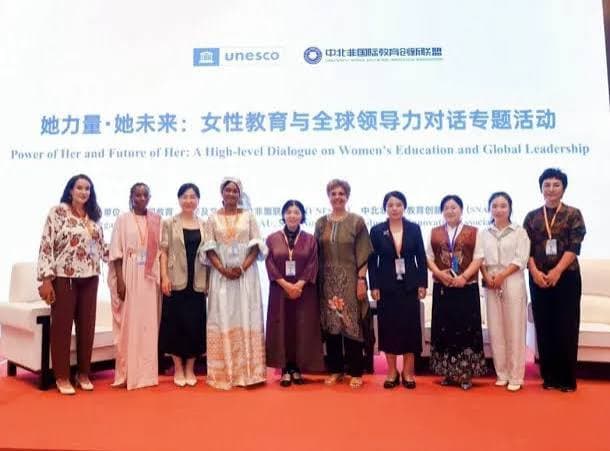
A new China-Africa cooperation initiative focused specifically on women's leadership has been launched through a partnership between UNESCO and the Sino-National Academy for Education Innovation and Application (SNAEIA). Called the Empower-Her Initiative, it represents one of the more substantive attempts to place gender equity at the centre of the growing China-Africa relationship, rather than treating it as a footnote to trade and infrastructure agreements.
The initiative's goals are specific: to strengthen women's opportunities in education, technology, and development leadership across African countries, and to deepen the long-term institutional relationship between China and Africa through gender-inclusive programming. UNESCO brings its global network, technical expertise, and ability to identify high-potential participants across its African member states; SNAEIA leads programme delivery and manages engagement with Chinese institutions.
The Empower-Her Initiative is designed to contribute to six Sustainable Development Goals simultaneously — SDGs 4, 5, 8, 9, 10, and 17 — covering quality education, gender equality, decent work and economic growth, industry and innovation, reduced inequalities, and partnerships for the goals. That multi-SDG framing reflects the integrated nature of the problem: women's exclusion from leadership is not a single issue but a compound one, requiring intervention across education, skills, economic access, and institutional design.
The timing is significant. China's engagement with Africa has grown enormously over the past two decades, primarily through infrastructure investment, trade relationships, and development financing. The Empower-Her Initiative represents an effort to ensure that gender equity becomes part of the architecture of that cooperation — not as a reputational gesture, but as a structural commitment with UNESCO's convening power behind it.
For African women professionals in education, technology, and development sectors, the initiative offers access to networks and institutional partnerships that were previously difficult to reach through China-Africa channels. Whether the programme delivers on that promise will depend on how participant selection is handled and whether the institutional partnerships it catalyses lead to lasting opportunities.
The initiative is a step in the right direction. What will matter most is whether, in three to five years, it can point to women who advanced into leadership positions as a direct result — and whether those gains are distributed across countries and income levels rather than concentrated in capital-city elites.