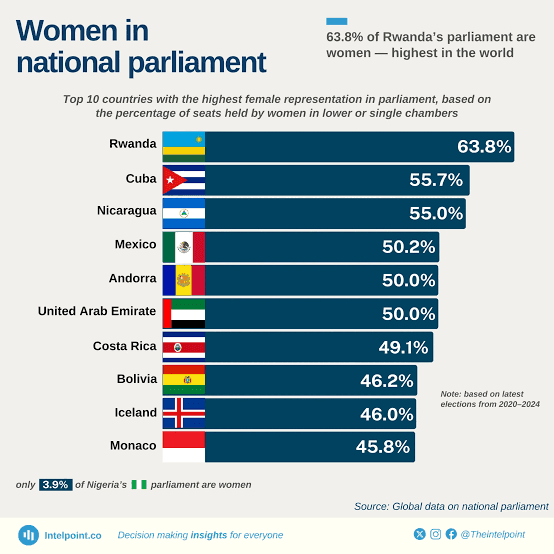
Rwanda has once again confirmed its position as the global leader in women's political representation, with the latest data from the Inter-Parliamentary Union showing women hold 63.8% of seats in the country's Chamber of Deputies as of early 2026 — comfortably the highest proportion of any national parliament in the world, ahead of Cuba, Nicaragua, Mexico, Andorra, and the United Arab Emirates. The achievement traces back to Rwanda's 2003 constitution, drafted less than a decade after the 1994 genocide against the Tutsi, which introduced a mandatory 30% quota for women in decision-making roles — a threshold the country has since more than doubled. Rwanda's parliamentary gains have translated into governance beyond symbolic representation: women lawmakers have driven legislative reforms strengthening women's rights, inheritance, and property ownership, expanded access to education and healthcare for children and mothers, and tightened legislation addressing gender-based violence. Women also hold roughly half of Rwanda's cabinet positions, giving the country one of the most gender-balanced executive branches on the continent alongside its legislature. Globally, women occupy just 27.5% of parliamentary seats on average, according to UN Women, making Rwanda's figures more than double the worldwide norm and placing it well ahead of the sub-Saharan African regional average of 27%. Rwanda's example has increasingly influenced neighbouring countries: Senegal, South Africa, and Namibia have each moved to increase female representation in their own legislatures, with international development bodies frequently citing Rwanda's post-genocide reconstruction as evidence that women's participation in governance can produce more stable and equitable institutions. The country's rise has an unusual origin: in the aftermath of the 1994 genocide against the Tutsi, Rwanda's population skewed heavily female, and rather than reverting to pre-genocide gender roles during reconstruction, women stepped directly into leadership — a shift the constitutional quota then formalised and sustained.
POLITICS
Rwanda Holds Onto Its Title as the World's Most Gender-Balanced Parliament
Rwanda has once again confirmed its position as the global leader in women's political representation, with the latest data from the Inter-Parliamentary Union showing women hold 63.8% of seats in the country's Chamber of Deputies as of early 2026
Tewa·September 21, 2026