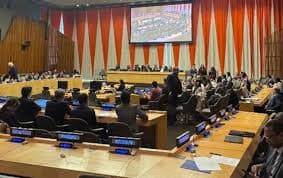
The African Union used the margins of the 81st session of the United Nations General Assembly to convene a high-level meeting on Women, Peace and Security, bringing together African governments, the African Women Leaders Network, and UNDP under a framework designed to move the Women, Peace and Security agenda from aspiration to measurable action.
The meeting, held on September 21, 2026, addressed a challenge that has frustrated advocates for years: the gap between formal commitments to Women, Peace and Security — including national action plans, AU protocols, and Security Council resolutions — and what actually happens on the ground in conflict-affected African countries, where women continue to bear a disproportionate burden of violence while remaining systematically excluded from peace processes.
AU Commission Chairperson Moussa Faki Mahamat reaffirmed the AU's commitment to the Women, Peace and Security agenda, emphasising that women's voices and leadership must be reflected throughout peace processes — not as observers or recipients of humanitarian aid, but as decision-makers with seats at the negotiating table and formal roles in post-conflict governance.
One of the meeting's concrete outputs was the launch of pilot training on monitoring Women, Peace and Security initiatives. This addresses a critical weakness in existing frameworks: the lack of systematic, comparable data on whether WPS commitments are being implemented. Without reliable monitoring, accountability is impossible — governments can endorse frameworks without consequence, and the gap between formal commitment and reality remains invisible.
UNDP's Africa Facility to Support Women's Political Participation was also highlighted as a mechanism for translating the high-level commitments made at events like UNGA into sustained, country-level support for women's political inclusion.
For the Women, Peace and Security agenda to advance meaningfully, it needs exactly what this meeting attempted to build: stronger monitoring tools, institutional accountability, and the sustained engagement of African governments beyond the conference circuit. The AU's convening of this meeting signals political will. Whether that will translates into the funding, the institutional reform, and the hard political choices that genuine implementation requires will be the test of what was achieved in New York.